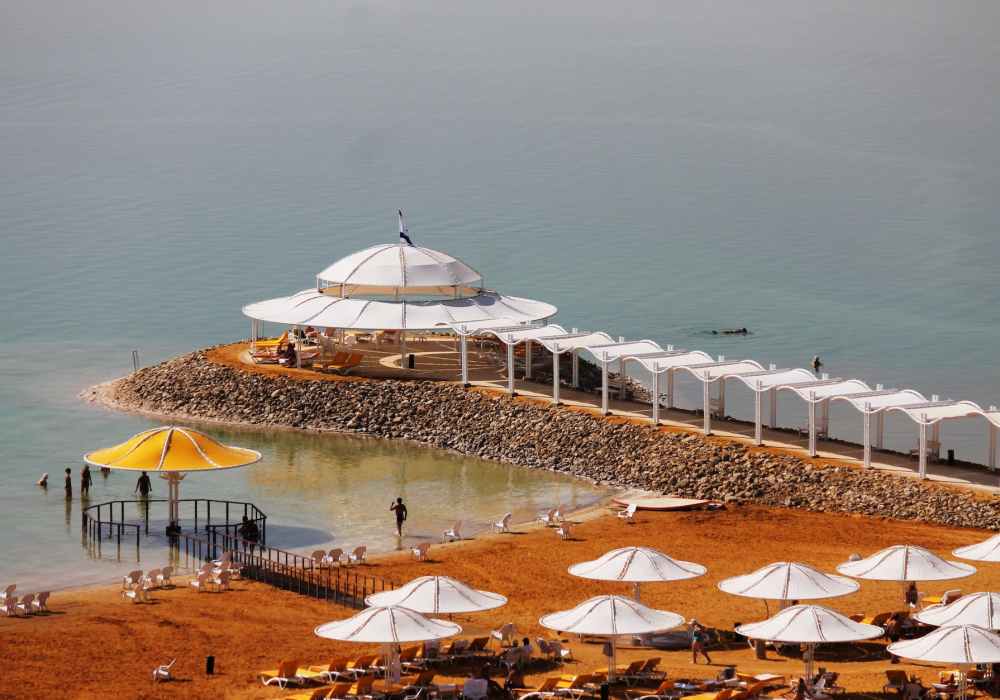
I’ve taken a long break from writing, and I’d like to say that it was because I was doing something fun, but it hasn’t been. I’m back in California for an extended period of time, and, while I’m not fully ready to discuss it, I thought getting back into writing about things that make me happy may help me start to feel better.
Day 6 in Israel took us to the Dead Sea. It was hot….like 40 degrees hot. We were there in the late afternoon, and it still did nothing to cool the water.


You really do float in the Dead Sea, and it really does wonders for your skin. I did not go out too far because I was barefoot and the sea floor is not fun on your bare feet. But I did enjoy the benefits of the salt water for the next few weeks.
Before we arrived at the sea, we spent the day on the Sea of Galilee taking a boat ride and enjoying the Ginosar Kibbutz. According to jesusboat.com:
The Kibbutz was founded in 1937 by idealist Zionist youth, and was named after the ancient city. Its most famous resident, Yigal Alon (1918-1980), was one of the Israeli Army’s most notable commanders and a prominent minister in Israel’s governments. Despite being surrounded by hostile population in its initial years of existence, Kibbutz Ginosar quickly gained a reputation for the warm hospitality that it provides for travelers. Among the many people hosted by the Kibbutz was Hannah Szenes, who later became a symbol of heroism for Israeli youth when she joined a daring mission behind the enemy lines during World War II, from which she did not return. Szenes stayed at the Kibbutz during a trip at the area in 1940, and described in her diary how impressed she was with the resident’s struggle.
In 1986, two brothers from the Kibbutz have discovered the remains of the ancient boat on the northwest shore of the Sea of the Galilee. 27 feet long and 7.5 feet wide, the boat was constructed of ten different kinds of wood, and was meant to allow fishing close to the shore. The extraction and preservation process of the boat was long and complex, and now it can be seen at the Kibbutz’s museum.
It was the dating of the boat using radiocarbon dating which brought the real exciting news: the boat dates back to the time of Jesus Christ. Indeed, it fits the many description of boats from the Holy Scriptures, as the one mentioned in the Gospel of Luke. A sign that the boat relates to sacred times was given at the time of its discovery: the two brothers who discovered the boat reported seeing a double rainbow in the sky on the same day.
https://www.jesusboat.com/ginosar-home-of-jesus-boat/

We then went on to visit Capernaum, where Jesus is said to have entered the synagogue to teach, before heading to the Mount of Beatitudes, where he preached the Sermon on the Mount. We finally got to see a temple, and not just any synagogue, but the Synagogue of Capernaum, which was built in the 4th century and is also known as the ‘The White Synagogue” as it was built from white stones from nearby Galilee and was a beacon amongst the typical grey buildings of the area. It is known as one of the oldest synagogues in the world, and according to Wikipedia:
The building consists of four parts: the praying hall, the western patio, a southern balustrade and a small room at the northwest of the building. The praying hall measured 24.4 by 18.65 m (80.1 by 61.2 ft), with the southern face looking toward Jerusalem. The internal walls were covered with painted plaster and fine stucco work found during the excavations. Watzinger, like Orfali, believed that there had been an upper floor reserved for women, with access by means of an external staircase located in the small room, but this opinion was not substantiated by the later excavations of the site.
https://en.wikipedia.org/wiki/Capernaum

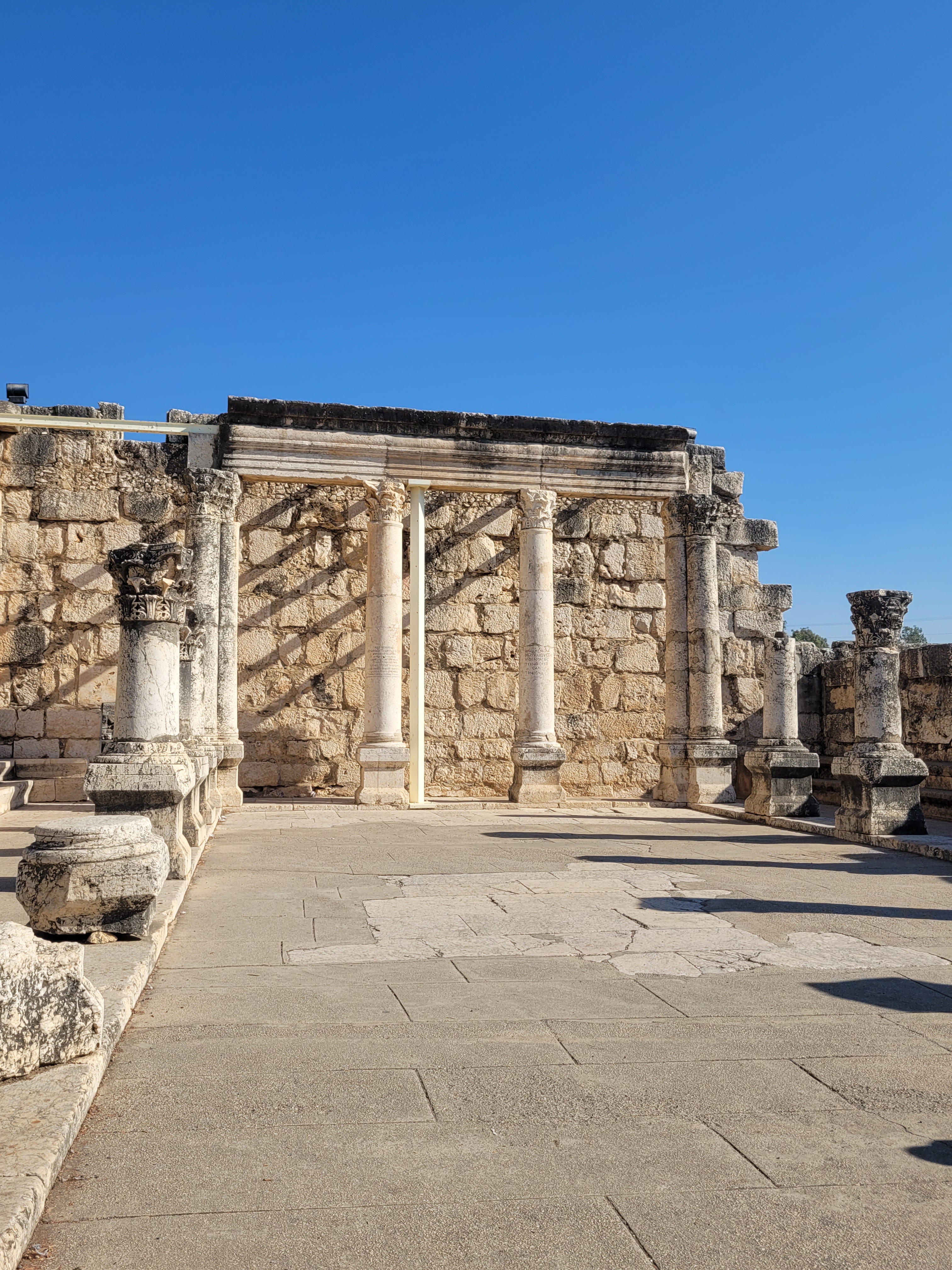
Next to the synagogue is the House of Peter.
One block of homes, called by the Franciscan excavators the sacra insula or “holy insula” (“insula” refers to a block of homes around a courtyard) was found to have a complex history. Located between the synagogue and the lake shore, it was found near the front of a labyrinth of houses from many different periods. Three principal layers have been identified:
- A group of private houses built around the 1st century BC which remained in use until the early 4th century.
- The great transformation of one of the homes in the 4th century.
- The octagonal church built in the middle of the 5th century.
The excavators concluded that one house in the village was venerated as the house of Peter the fisherman as early as the mid-1st century, with two churches having been constructed over it
https://en.wikipedia.org/wiki/Capernaum
I’m not sure how I feel about modern churches being built over ancient sites, but I guess that is always going to be a thing. It was another day of listening to Rafi and really enjoying his stories and the way that he presented the history. As I mentioned in the last post, I really wish that I had journaled as we went so I could have captured all of the things that we learned, but I was just so happy to be in Israel and be with my parents that I did not think about being a good little travel writer.
 The Scamp Abroad