The Scamp Gets Ready for Pesach

Before I get into the fun that I am having preparing for Passover, I want it to be known that this is post 499 of The Adventures of a Scamp Abroad. I always have a big post planned for the different milestones, and my 500th post will be no different.

Now on to the matters at hand. Sundown tonight marks the start of one of my favourite holidays, Pesach (also known as Passover). I love Passover for the same reason I love Thanksgiving, it is the holiday where everyone comes together as a family to celebrate.

But what is Passover you might ask? The good people at chabad.org have put together a really nice explanation of the holiday.

The eight-day festival of Passover is celebrated in the early spring, from the 15th through the 22nd of the Hebrew month of Nissan, April 8 – April 16, 2020. Passover (Pesach) commemorates the emancipation of the Israelites from slavery in ancient Egypt. Pesach is observed by avoiding leaven, and highlighted by the Seder meals that include four cups of wine, eating matzah and bitter herbs, and retelling the story of the Exodus.

In Hebrew it is known as Pesach (which means “to pass over”), because G‑d passed over the Jewish homes when killing the Egyptian firstborn on the very first Passover eve.

The Passover Story in a Nutshell

After many decades of slavery to the Egyptian pharaohs, during which time the Israelites were subjected to backbreaking labor and unbearable horrors, G‑d saw the people’s distress and sent Moses to Pharaoh with a message: “Send forth My people, so that they may serve Me.” But despite numerous warnings, Pharaoh refused to heed G‑d’s command. G‑d then sent upon Egypt ten devastating plagues, afflicting them and destroying everything from their livestock to their crops.

At the stroke of midnight of 15 Nissan in the year 2448 from creation (1313 BCE), G‑d visited the last of the ten plagues on the Egyptians, killing all their firstborn. While doing so, G‑d spared the children of Israel, “passing over” their homes—hence the name of the holiday. Pharaoh’s resistance was broken, and he virtually chased his former slaves out of the land. The Israelites left in such a hurry, in fact, that the bread they baked as provisions for the way did not have time to rise. Six hundred thousand adult males, plus many more women and children, left Egypt on that day and began the trek to Mount Sinai and their birth as G‑d’s chosen people.

The holiday is celebrated with a seder. This is a retelling of the Jews exodus from Egypt and a time for both young and old to come together and think about their history. That history is in the Haggadah, or central reading for the seder. As My Jewish Learning states

The script for this central ritual of Passover is the Haggadah (literally, “telling”). It contains questions and answers, stories, show and tell, song, food as reward and symbol, pathos, and suspense. The creation of this script took place over hundreds of years at the beginning of the Common Era. There is evidence that parts of the seder were in a fixed format by the time of the Mishnah (second to third century CE). Midrashim were added and the current traditional version was fixed soon after.

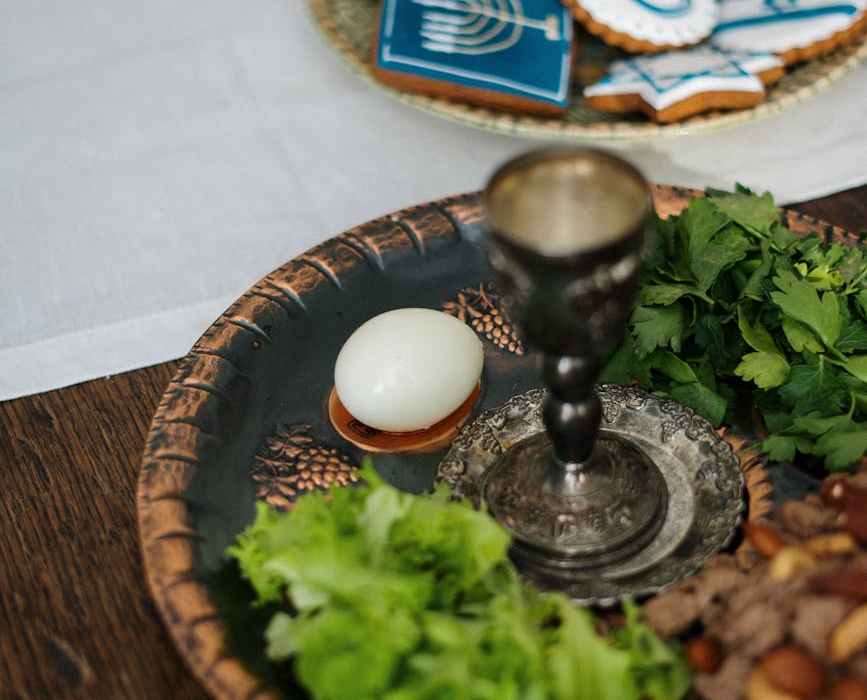
There is a seder plate that represents the various themes of the Haggadah (I’ve provided a link to a nifty little video to explain the significance).

The Seder Plate

Just for fun, My Jewish Learning has also put together a list of vocabulary to help everyone at their first seder. They are:

Passover Greetings (in alphabetical order)

A zissen Pesach — Have a sweet Passover! (Yiddish)

Chag aviv sameach — Have a happy spring holiday! (Hebrew)


Chag kasher sameach — Have a happy and kosher holiday! (Hebrew)

Chag sameach — Have a happy holiday! (Hebrew)

Moadim l’simcha — May your times be joyous! (Hebrew, said only during the Hol Hamoed, or intermediate, days of the holiday)

Passover Vocabulary (in alphabetical order)

Afikomen —From a Greek word meaning “dessert.” A piece of matzah that is hidden during the course of the seder , found after dinner, and eaten as dessert at the end of the seder meal.

Arba Kosot — Hebrew for “four cups.” In this case, it refers to the four cups of wine drunk at the Passover seder.

Barekh— The 12th step of the Passover seder, in which Birkat Hamazon, the grace after meals is said.

Beitzah — Hebrew for “egg.” A roasted or hard-boiled egg is placed on the seder plate to symbolize rebirth.

Chad Gadya —Aramaic for “one goat,” this is the last of the songs sung at the conclusion of the seder and tells the story of the little goat a father bought for a pittance. Listen to the song below. Find lyrics here.

Chag Ha Aviv — Hebrew for “The Spring Holiday.” One of the alternate names for Passover.

Dayenu — Hebrew for “enough for us,” this is the name of a song sung at the Passover seder that tells of all the miracles God performed for the Israelites. Listen to it and see the transliteration in this video below.


Gebrochts — Yiddish for “broken,” this refers to matzah that has absorbed liquid. It is customary among some Orthodox Ashkenazi Jews to avoid gebrochts as an extra stringency on Passover.

Haggadah — Hebrew for “telling” or “recounting.” A Haggadah is a book that is used to tell the story of the Exodus at the seder. There are many versions available ranging from very traditional to nontraditional, and you can also make your own.

Hallel — The 13th step of the Passover seder, in which psalms of praise are sung.

Hametz — Bread or any food that has been leavened or contains a leavening agent, hametz is prohibited on Passover.

Haroset — A sweet mixture of nuts, wine, and apples on the seder plate that symbolizes the mortar used by slaves in Egypt.

Hol HaMoed — The intermediate days of the holiday, between the first two days of holiday, and the last two days of holiday.

Kaddesh —  The first step of the Passover seder, in which a blessing over a glass is recited.

Karpas — The third step of the Passover seder, in which a piece of greenery such as parsley is dipped into salt water and then eaten.

Kitniyot — Hebrew for legumes, the term here also includes corn and rice. These items were prohibited for use on Passover by some Ashkenazic rabbis in the medieval period, but many Sephardic Jews (and increasingly Conservative Jews) do allow them on Passover.

Korekh — The ninth step in the Passover seder, in which bitter herbs are eaten together with a piece of matzah.

Maggid — The fifth and most substantial step of the Passover seder, in which the story of the Exodus is recounted.

Maror — Bitter herbs. The eighth step in the Passover seder, in which the herbs (usually horseradish), symbolizing the bitterness of life under Egyptian rule, are eaten.

Matzah — Unleavened bread. According to the Bible the Israelites ate matzah right before they left Egypt. Today matzah is eaten during Passover to commemorate the Exodus from Egypt.

Motzi Matzah — The seventh step in the Passover seder, in which a piece of matzah is eaten.

Nirtzah — The 14th and final step of the Passover seder, in which the night is concluded by saying “Next year in Jerusalem.”

Pesach —Hebrew for “pass over.” Cooked meat that, according to the Bible, was eaten by the Israelites just before they left Egypt.

Rahtza — The sixth step of the Passover seder, in which the hands are washed for a second time, and a blessing is recited.

Seder — Hebrew for “order.” The Passover ritual where family and friends gather on the first one or two nights of Passover to retell the story of the Exodus. The story is told in a particular order, with specific rituals.

Shir Hashirim — The Song of Songs, the text read in synagogue during the Shabbat of Passover.

Shulhan Orekh— The 10th step in the Passover seder, in which the meal is served. Pass the matzah balls!

Tzafun — The 11th step of the Passover seder, in which the afikoman is found and eaten as dessert.

Urchatz — The second step of the Passover seder, in which the hands are washed but no blessing is recited.

Yahatz — The fourth step of the Passover seder in which a piece of matzah is broken in half.

Zeroa — Shank bone. The bone is placed on the seder plate and recalls the blood on the doorposts and the terror and the anticipation of the night of the plague of the first born.

In my family, Passover is always celebrated at my Great Aunt’s house with a big seder and something fun to tie the kids in. The last one I went to had a play before dinner, and a few years ago we had plastic plagues that we all threw at each other during the readings. I miss these traditions when being so far away, and in a country that is not exactly Jewish friendly, but I have not let it stop me from trying to celebrate in my own way.

This year is extra strange given that we are on lockdown and can’t get together even if we wanted to. I’ve got most of the supplies that I need (although there is no matzah at any of the stores I am allowed to go to, and I can’t really be out and about all day trying to hunt it down…I do have some flat crackers though as a stand-in. Same with the Haroset, but I have a sweet jam that should do the trick). Tomorrow I’ll use my electronic version of the Haggadah, stretch out on my couch and have some unlevean bread and some sweet macaroons for dessert.

Hopefully next year I won’t be in lockdown so I can be better prepared with the food options for the seder, and maybe I can talk some of my friends here into attending. So until then, chag sameach everyone and find a fun way to celebrate!

References 

The Passover (Pesach) Seder

https://www.chabad.org/holidays/passover/pesach_cdo/aid/871715/jewish/What-Is-Passover-Pesach.htm
Must-Know Passover Terms

The Scamp in Isolation

I have been practicing social distancing for the last 5 years. It is an unfortunate by-product of my PhD experience and horrible taste in men.  Two months before the official lockdown I had really started to isolate myself so that I could finish the rewrite and get it in on time.

I was supposed to leave for China to represent the office, and then come back to a new life where I could see my friends more often, take up a hobby that did not involve schoolwork, and finally be free of Napier.

I was going to be a new Kim.

Instead, I have basically been in quarantine since March 17th. My compromised immune system means I am potentially at a higher risk for infection, and I figured with my luck, I’d catch everything you could including Covid19 when my body finally relaxed after the rewrite was complete. I did not leave my place for a week because of a cold, and then for fear of the lackadaisical attitude of the people where I live about staying inside. I finally got to the point last week where I was willing to risk germs for my government-approved exercise outside once a day.

But it is just making me angry. No one here takes it seriously. People are working in their allotments, hanging out in the parks, and walking, jogging and cycling way too close to each other. I’m ready to scream. I’m also mourning the cancellation of my upcoming trip to Mallorca, and what will probably be the cancellation of my family’s trip here in July for my graduation ( the ceremony which has also been canceled).

I’m also lonely. I spend all but about 30 minutes at the start of my day with only myself for company….and I am not good company. That’s not entirely true. My family and friends have been amazing. I get calls and videos and photos all the time. I also have very considerate colleagues who check-in when they notice me looking a little down on the video chats in the morning.

I have been trying to work out and do things that keep my brain occupied, but with the warm weather taunting me, and cabin fever getting the best of me, I cannot wait for things to settle back into a normal where people are not getting sick and we can all go outside again.

Because I hate being a downer, I just want to say that I admire all of the nurses, doctors, pharmacy workers, and grocery store workers who are coming to work every day without complaint and demonstrating a courage and bravery that I can only hope to emulate one day. I have several friends in the US that are total badasses, and several former students here in Scotland that I could not be more proud of. It is nice to know that there is still some good in the world.

The Scamp Says a Fond Farewell

Last night, after five wonderful years together, I said my final goodbye to my trusty laptop. My mom and dad bought me the laptop before I moved back to Scotland fulltime (I think, although it might have been a bit before that, I can’t really remember). It is the third or fourth Dell that I’ve owned, and I’ve gotten my money’s worth out of all of them.

That laptop has been through a lot. Countless train rides, trips on the bus, flights. It has helped me mark hundreds of papers, answer who knows how many emails, and write quite a few posts on my way to 500. I’ve had many skype chats, instant message exchanges and therapy sessions using that laptop.

I wrote the entire first draft of my PhD on that laptop. I did 85% of the research for my thesis on that laptop.

It was a good piece of equipment. There were only two times I can think of when something went wrong with it, and one wasn’t until about a year ago when the battery quick and it could only be used if plugged in.

I am stuck in lockdown at the moment so I have yet to recycle it. I wish it could be fixed and then donated somewhere to help someone who needs one given the current lockdown situation, but unfortunately, it would cost more to repair then it is worth.

So for now, while everything is closed and I can’t leave my flat it is a very large paperweight collecting dust in the corner.

The Scamp Finishes a Project

Today I finished the corrections for my PhD. I’ve spent the last 6 months in agony since the disastrous viva. I avoided the corrections for about a month and half, and then the pressures of a fulltime job got the better of me and I lost the motivation to work on it. When I went to California for Christmas, I spent three weeks writing like mad and managed to get quite a bit of the rewrite done. I was feeling pretty good about myself. That slowed and then halted when I  came back to Scotland, partly because I was back to work, and partly because I came back to Scotland feeling like I hadn’t actually had a vacation.

I’ve spent the last month fighting a battle between work, fatigue and these stupid chapters. The last couple of weeks has been me staying up late, ignoring my work commitments and completely isolating myself to get it done.

But I am finally done. I think this is a better piece of work. It was the thesis that I wanted to write 5 years ago. It is something that I am proud to have my name on.  I will submit tomorrow and hope and pray that the examiners have a heart and accept the corrections. I literally have no way of knowing if they will. If they don’t, I am not sure what I will do. At the moment though, I am way too tired to think about it. I’m also behind in my work. I was meant to be taking some days off starting tomorrow, but I think I am going to have to cancel the time off so that I can attempt to catch up. To be honest, I can’t travel, so I would be working on the marking and all the work that has piled up, so I might as well get paid for it.

The annual leave can wait until I can sit on the beach again.

Here are the dedication, acknowledgment and the abstract in case anyone is curious about what the work is all about and the people that really helped me through.

This thesis is dedicated to all the graduate students who lost their lives, in part, or as a consequence of pursuing a PhD.

You deserved the opportunity to write your own thesis.

May you always be remembered as part of mine


ACKNOWLEDGEMENTS

This thesis has been a labour of love (and sometimes loathing), and there are several people that deserve much more than a few lines at the start of this work.

Thanks to:

  • Tansy Jessop for having lunch with me at the 2015 Assessment and Higher Education conference and making sure that my TESTA journey was a successful one.


  • David Carless for helping me refine the recommendations and pointing me in the direction of a strong definition of feedback.


  • David Nicol for saying to me, ‘You should be critiquing my model! It worked in the time it was written, but it is time for something new’. You will never know how much that bolstered my self-confidence.


  • Joan McLatchie, Velda McCune and Mark Huxham – thanks for taking a chance on a cat loving Californian.


  • The Llama Ladies- You are the best friends a girl could ask for.


  • Errol Rivera- You talked me off many a ledge and helped me outline many a draft chapter. I’m forever grateful.


  • Joe Ameen- A million thanks for the chats and life advice.


  • Dr Ana Georgieva- You kept me sane and reminded me to be kind to myself.


  • Martha Caddell- You are the best mentor a girl could ever want. I hope I’m half as great as you one day.


  • Anne Tierney-Because everything’s better with puppets!


  • Kelsey Austin- My travel buddy, my heterolifemate, my unwavering support. I love you and our many adventures.


  • Declan- you know why.


  • Mondo, Brandon, Jackson, and Matt- I love you.


  • Wombmate-You gave me nephews, you listened to me cry and you never let me forget that I am better than my anxiety.


  • My parents, Rick and Michelle- I’ll never be able to pay back what you’ve given me. Thank you for never squashing my wanderlust and for all the support. I love you to the moon and back.


ABSTRACT


In designing sustainable feedback practices, it is crucial to consider the kinds of learning that higher education is intended to cultivate. This research study investigates how a programme-focused approach to curriculum design affected a students’ feedback literacy. This research stems from the growing focus on feedback literacy and what that implies for student engagement with feedback as a learning tool (Carless & Boud, 2018; Molloy et al, 2019; Han & Xu, 2019). While the current research focuses on feedback literacy at the student or individual module level, this study investigates what features of a programme can help, or hinder, a student’s feedback literacy journey. In this context, feedback literacy will be defined according to Carless and Boud (2018, p.1316) as:


the understandings, capacities and dispositions needed to make sense of information and use it to enhance work or learning strategies.


Based on a review of the literature on feedback and feedback literacy, a survey was distributed to students across five programmes at Edinburgh Napier University. Semi-structured interviews were conducted with the programme leaders as well as module leaders, and follow-up focus groups were conducted with the students who participated in the survey. Analysis of the findings found that there were five programme characteristics that factored into a student’s engagement with feedback literacy. They are:


  1. Staff attitudes to feedback
  2. Whether there is a programme-focused approach
  3. Students’ role in feedback
  4. Whether there is a sustained approach to feedback
  5. Institutional acceptance of the challenges of developing a sustained approach to feedback


On this basis, it is recommended that not only do programmes consider a programme-focused approach to assessment and feedback, but that in order to help further the development of the students’ feedback literacy, staff must first be feedback literate themselves. Further research is needed to identify whether a shift in programme structure has an overall impact on student engagement with feedback and leads to the development of a stronger feedback literacy.

The Scamp Gets Mad at a Virus

Today I was supposed to be packing my bags and getting ready for a week-long work trip to China. I’ve never been to Asia, and while it wasn’t a place I was dying to go, I was looking forward to exploring a completely different culture and spending the week working in a new place.

Today I rushed around the office preparing for a possible shut down amid the growing fear of Covid19. Needless to say, I am not going to China. Truthfully, I am glad I don’t have to go. The trip has been rescheduled, and I will happily go when it is safe to do so, but right now, I am so overwhelmed trying to get the PhD finished that I am not sure how I would be able to focus on anything else. My corrections are due in less than a week and my supervisors have gone missing. I do not have a complete draft as of now, and would not pass the corrections if I turned in what I have.

I’m panicked.

It also turns out I may have been exposed to the stupid Covid19. For most of the last couple of months, while the world has been monitoring the situation, Scotland has remained largely unaffected. I was concerned, but no more so than about catching the flu or other illness due to my immunocompromised state. Now that it has made it Scotland, and potentially to the university that I work for, there is a chance that those stupid germs could make it into my breathing space. At the moment I am okay. I’m tired, feel achy, but that it is just as much from the stress and the not sleeping. I don’t have a fever, cough, and at my last blood test, my white cell count was okay.

But given my luck, I will get sick and it will further derail my PhD completion. It has already been delayed for almost two years. I am not going to be happy if it is delayed further.

The bright spot today was my colleagues.  Everyone knows how stressed I am, and people offered to help me with my work all day. I talked to our media team about some image captioning, and even though one of the members did not think it was necessary, he offered to put aside his work to help me finish mine. Another colleague brought me an emergency cookie and offered a hug and some moral support. She is currently working the job of two people, but again, was willing to put her work aside to spend a few minutes letting me cry on her shoulder. The people that I share my office with have been the best support so far. They let me have a whinge about the work, they answer my questions, take breaks to chat about nonsense, and have made sure that I do not get too overwhelmed with everything that is currently on my plate.

It is times like this that I am reminded why I like my job (well beyond the obvious that they sponsor my visa and make it possible for me to live in Scotland).

Hopefully, the stupid plague leaves me alone. Hopefully, it leaves a lot of people alone. Hopefully, I finish my corrections so that I can finally get the PhD. Hopefully, the travel ban is lifted so I can still go on the holiday to Spain that I booked months ago so I could decompress from the PhD madness. I need that beach time. I mean, I really need it. I am literally white enough to be seen from space. This is not good for my self-esteem.

The Scamp Observes Some Teaching

One of the things I love most about my job is that every semester I get to do teaching observations.

I’m not always a fan of the observing part, but I am a fan of the chance to see all the different types of classes that are taking place on campus.

Today was a new one. Today the lecture I attended was in a church.

That’s right…..a church. The pews served as desks, a massive projector was set up in front of where the services are led (unfortunately I do not know the proper name…pulpit?) and a very nice man from the church was on hand to make sure that the mics worked and the students could hear the lecturer.

It was by far the oddest observation I have ever been to. It felt wrong to be sitting in a church learning about something that had nothing to do with religion, but since I am assuming the university pays the church and given that the person that I was observing does most of their teaching at the church.

I have to say, the novelty of going to a lecture in a church meant that I could ignore the fact that the lecture that I was observing was so over my head that it might as well been taught in Klingon.

I’m using this as a distraction to the fact that I have 1 month left to complete a rewrite of a thesis. I still have one chapter that needs to be written and still have lingering doubts that I am going to complete it on time, or that what I have is good enough for them to sign off on.

I am still hating the uncertainty of this nightmare PhD.

The Scamp Answers a Question

I’m still on the quest to write for fun at least two days a week. Fun is hard to come by right at the moment, so I am going to rely on an old set of journal prompts to get me thinking about something other than work…..except when I opened the document for the question that went with today’s date, that question was:

Tell me something weird about your day.

The thing is, there was nothing really weird about the day. Not a thing. If this question had come yesterday I could have discussed the fact that this crazy storm we are in the middle of has the weather all messed up. Yesterday was thunder, lightning and snow.

Yes, snow. I didn’t know it was possible to have a thunder/snowstorm. The thunder shook the whole building. It was just part of a day of weird weather. I was doing a teaching observation in the middle of the day. When I left my office there was a light flurry of snow, but nothing terrible. I sat facing the windows so I could see the lecturer and the students during the session….and that was a mistake. By the time the lecture started, there was a full-on blizzard. I’ve never seen it snow so hard in person. At one point between the wind and the snow, it sounds like the windows were being pelted by rocks. Not to mention that you could not see two feet in front of you. I was so distracted by the snow at one point that because of the lecturer’s accent, I thought he said murders and acquisitions rather than mergers and acquisitions.

I’m not going to lie, a class on murders and acquisitions might not be a bad idea.

I was able to sneak off a little early and make it home without any disruption to the trains, or anything more than just icy streets in Edinburgh, but compared to that, today was ordinary.

I need ordinary though. Ordinary is what is going to get me through the next month and hopefully allow me to finish the thesis and maybe, just maybe, pass and be done with a pretty shit experience.

The Scamp Needs Reassurance

I’ve already failed at the 20 things I want to do in 2020. I only managed one post last week instead of two. This puts me in a bad mood. I can’t keep to a simple plan.

Same with the diet right now. I’m terrified of what will happen if I step on a scale right now. I’m frustrated that I cannot resist falling into old bad habits.

I am feeling the weight of the world on my shoulders.

My PhD edits are due in a little over a month. At the moment I only have two chapters that are done. I spent three weeks in California and was able to write four chapters. I have feedback on two waiting for my attention. I have one chapter that needs to be written.

I am running out of time.

Last week I had a meeting with my supervisor about the feedback on my chapters. The feedback was good. It is constructive, it is detailed. It will hopefully get me on track to pass. When I told my supervisor that I was worried that I would not pass the corrections, instead of telling me that I would be okay and that I would pass, she told me that she cannot guarantee that I will pass. She did not want to give me any false promises and it was out of our hands. During the same conversation, she said if I pass the corrections then she has carried me through the PhD and deserves to be the one who hoods me at graduation.

Now, I want to qualify this. While I do feel a little undervalued and very much abandoned by my supervisors, I do love Joan. She has carried me through the process because I have given up. I spent four years being mucked about and because of that I almost failed. They told me the whole time they were not worried about me during the viva and no one expected me to have to rewrite the thesis. She is the only one who is helping me the corrections, the only one who was there on viva day and is really the only one who stood up for me during the process. I want her to be the one to give me my hood. I also know that she doesn’t want to lie to me, especially given what I went through in the viva, so I do appreciate that she is being honest with me.

But let me tell you how my brain works.

It does not work with a lack of reassurance that I will be successful if I make the corrections. It then immediately fixates on the fact that if I mess this up I don’t get the PhD. If I don’t have the PhD, then I am no longer eligible for my job. If I lose the job, I lose the visa. If I lose the visa, I get deported. If I go back to California, I will have no job, massive student loans and nowhere to live.

Then I have the constant barrage of questions about when I graduate when I’ll be done, why haven’t I finished. Not to mention the recrimination of not answering emails fast enough, not responding to things I cannot emotionally handle, and for not driving all over the state of California at Christmas to see people who really haven’t made that much effort to be my friend and support me.

I’ve just about had it. I cannot work without a little reassurance, without a little support, and right now, I am not getting it. I’m not exactly making it easy for people, but I do not want to have to do so much work to be supported. I also don’t want to hear everything is going to be okay, or that I am smart enough or that I know what I need to do. I need a hug. I need someone to take my debit card away so I can’t buy crap food to eat. I need someone to text me just to say hi how are you.

I need people to stop comparing their suffering to mine. I know that eventually, I will be okay and that there are a lot of people who are struggling a lot more than I am with a lot more difficult issues. Logically I know this. But I am tired and my brain does not work logically right now. I will be so happy when this PhD process is over and I can move on.

I saw a tweet the other day about whether or not a PhD was worth it. The woman who write felt like it wasn’t. Now that I have almost completed 2, I am starting to wonder if what she thinks is true.

I felt like I needed to put this out in the world so that I might be able to find the motivation to keep going.

But the next post. That one is going to be writing for fun….if I can remember what fun is.

The Scamp’s 20 things for 2020

Last year I only published four posts. Four. In 365 days I only managed to write for fun (well okay, not fun, mostly for therapy) four times. Almost a month into 2020 and I am not really feeling the fun writing either. I am 10 posts away from 500 and have had the Scamp adventures as my constant companion for almost ten years. Sometimes I wonder if I have run out of things to say.

Sometimes I wonder if the PhD killed my love of writing. Today I had a fight with FedEx. That fight and the frustration that comes from a week-long back and forth battle with them led me to lash out at the people around me and picking fights with people for absolutely no reason. One of those people has been a toxic existence in my life for the last four years. The thing is, I wanted to get rid of him a long time ago but I wasn’t strong enough. It is not easy to get rid of a manipulative sociopath when you are already beaten down emotionally by life.

The edits for my thesis are due in one month. I’m not done. I’m getting there, but not close enough to keep me from stressing. The final draft is due to the examiners by the 13th of March, and I have that marked on my calendar as the day my life begins. It is has been five years that I have been chained to the PhD, three of those in less than ideal circumstances, and two of those feeling utterly worthless and broken by the system. But on the 13th of March, I get to start living again.

I’m supposed to be on a flight to China that day, but with the given health warning, I am not sure that is going to happen. Regardless, I get to live again.

So, because I have not done things outside the PhD in way too long, I have decided to bring back one of my favourite things: making a list of things that I would like to do in during the year.  I did this before my 30th birthday and it was a lot of fun. It also gave me great pleasure to do the things on the list and cross them off. I love do love crossing things off a list.

In no particular order:

  1. Visit 3 new countries
  2. Present at an academic conference
  3. Solo author a paper
  4. Lose the 20lbs I gained in the last year due to bad choices and stress
  5. Do yoga at least twice a week
  6. Write at least one new post a week that has nothing to do with work
  7. Make a dent in my student loan
  8. Finally get my UK driving license
  9. Participate in No Screen Sunday and stay off my phone and all social media on Sundays (starting today because I have not done it at all this month)
  10. Keep the toxic people from returning to my bubble
  11. Ride in a hot air balloon
  12. Go camping
  13. Celebrate passing my viva
  14. Improve my Spanish proficiency
  15. Meal prep to help balance my diet (and to help with number 4)
  16. Get on an academic committee
  17. Officially change my name on all my documents without crying
  18. Go a full 48 hours without being negative
  19. Don’t cancel plans with friends once I’ve made them (especially not the day of)
  20. Finally get my artwork from California to Scotland (although not through FedEx)

I’m hoping that by writing the list down I can stay accountable and actually complete these things. I also hope that it means that I will be a lot happier in 2020 than I was in 2019.

The Scamp Reframes the Narrative

I’m struggling with my thesis edits. I’m struggling not just because I have to rewrite the entire thing in six months when the first draft took three years to complete, but because of what happened to me in those three years, what I had to endure there and then in the viva that have made it really hard for me to sit down and rewrite  my work in a way that is satisfactory to the people that control whether or not I get my degree.

This week the University and College Union called a strike at universities across Scotland over the rising cost of pensions and other pay and working conditions (this is the very simplified bare-bones way to explain it. You can find a more detailed explanation here: https://www.ucu.org.uk/). UCU issued a news update this week that I think really explains it well:

Guardian editorial said the marketisation of universities had seen a new breed of vice-chancellors emerge aping the language and salaries of a business CEO complete with an entourage of financial managers and marketing gurus. However staff had been left behind as their pay fell and an intellectual precariat was stumbling from year to year on temporary contracts wondering where the next teaching gig was coming from. While the Financial Times said that the industrial action carried wider significance than the fate of a disputed retirement plan, and had exposed the precariousness of Britain’s higher education system as it has become more of a marketplace.

So what does the strike and the fight for better pay, suitable contracts and fair working conditions?

Everything. See I am on one of those temporary contracts. I am paying a lot into my pension that could be helpful in paying my student loans. Full disclosure, I am not a member of the union so I am not allowed to strike even if I wanted to. But that is neither here nor there.  What I want to focus on is the last sentence in the paragraph from UCU. The working conditions of the UK’s higher education system.

See the thing is, it is not just the staff who are suffering. PhD students are also suffering. The expectation, the pay, and the complete disregard for the mental health and wellbeing of the students undertaking the role. These were battles that I had to face almost daily for four years and when I spoke up to the people that were in a position to help me, they either laughed in my face or told me not to worry. No one took me seriously. No one even acknowledged the possibility that my worries now may become actual problems in the future. At one point I was working on five different projects to scrape money together to pay my bills every month. I burned out twice. I cried every Friday with a therapist.

I made it all the way to a viva only to be told what I had done wasn’t even half good enough. I was failed by a lot of people, mainly my supervisors, and I could get in a lot of trouble for even putting that in writing. Yes, it is true that I could email my supervisors and ask for help. The thing is, I don’t even know what to ask for. The only one who would even respond would tell me that I know what I need to do and I just need to do it….and I really wish that was true. I have no idea what I need to do because I did what was expected of a PhD student, the examiners hated it, and now I am trying to do something that leaves out a lot of important information…..oh yeah, and I need to not mention the methodology that I used to collect the data because the examiners hated it.

It really hurts when people call me Dr Wilder….one because technically I am not, but two, because it is a slap in the face to be seen as an expert when I was told behind closed doors I wasn’t good enough, even though half the choices made were not made by me.

But dealing with that reality is not getting me anywhere. That attitude led me to not working on my thesis, making poor dietary choices, weight gain, ridiculous anxiety and my current (and starting to feel like permanent) grumpy state. So I am trying to refrain that narrative. But it’s hard. I want to go on strike and refuse to work under these conditions. I want to fight the people that put me in this position in the first place.

I want to not be afraid that I could lose my job because I cannot meet the needs of a system that does not care if I pass or fail as long as they get paid….and since they already got paid, there really is no reason to help me.

I am not really sure why I dumped all of this on my blog about being an expat. It isn’t fun. It isn’t happy. It isn’t even insightful. But I guess it makes me feel better to know that I am not incapable of writing. This is the most writing I have done at one time in months, and maybe, just maybe if I can go on strike against the conditions that I was forced to work in before and see this as an opportunity to really get a PhD with my work saying what I want to say and start helping university’s help their students with assessment and feedback. I think I am good at what I do. I think that once I put this nonsense behind me that I can continue with my work in an environment that supports me, encourages me, and is allowing me the chance to do things that I am good at and try to help people who want to enhance their assessment and feedback skills.

I am ten posts short of 500. I have no idea how I got to 500 posts, or what that special 500th post will look like, but I am excited that I am almost there. Maybe it is another sign from the universe that I can get the writing done and I can show the examiners that I earned the PhD that cost me a lot of blood, sweat, tears, friendships, and mental health.