The Scamp Gets Ready for Pesach
Before I get into the fun that I am having preparing for Passover, I want it to be known that this is post 499 of The Adventures of a Scamp Abroad. I always have a big post planned for the different milestones, and my 500th post will be no different.
Now on to the matters at hand. Sundown tonight marks the start of one of my favourite holidays, Pesach (also known as Passover). I love Passover for the same reason I love Thanksgiving, it is the holiday where everyone comes together as a family to celebrate.
But what is Passover you might ask? The good people at chabad.org have put together a really nice explanation of the holiday.
The eight-day festival of Passover is celebrated in the early spring, from the 15th through the 22nd of the Hebrew month of Nissan, April 8 – April 16, 2020. Passover (Pesach) commemorates the emancipation of the Israelites from slavery in ancient Egypt. Pesach is observed by avoiding leaven, and highlighted by the Seder meals that include four cups of wine, eating matzah and bitter herbs, and retelling the story of the Exodus.
In Hebrew it is known as Pesach (which means “to pass over”), because G‑d passed over the Jewish homes when killing the Egyptian firstborn on the very first Passover eve.
The Passover Story in a Nutshell
After many decades of slavery to the Egyptian pharaohs, during which time the Israelites were subjected to backbreaking labor and unbearable horrors, G‑d saw the people’s distress and sent Moses to Pharaoh with a message: “Send forth My people, so that they may serve Me.” But despite numerous warnings, Pharaoh refused to heed G‑d’s command. G‑d then sent upon Egypt ten devastating plagues, afflicting them and destroying everything from their livestock to their crops.
At the stroke of midnight of 15 Nissan in the year 2448 from creation (1313 BCE), G‑d visited the last of the ten plagues on the Egyptians, killing all their firstborn. While doing so, G‑d spared the children of Israel, “passing over” their homes—hence the name of the holiday. Pharaoh’s resistance was broken, and he virtually chased his former slaves out of the land. The Israelites left in such a hurry, in fact, that the bread they baked as provisions for the way did not have time to rise. Six hundred thousand adult males, plus many more women and children, left Egypt on that day and began the trek to Mount Sinai and their birth as G‑d’s chosen people.
The holiday is celebrated with a seder. This is a retelling of the Jews exodus from Egypt and a time for both young and old to come together and think about their history. That history is in the Haggadah, or central reading for the seder. As My Jewish Learning states
The script for this central ritual of Passover is the Haggadah (literally, “telling”). It contains questions and answers, stories, show and tell, song, food as reward and symbol, pathos, and suspense. The creation of this script took place over hundreds of years at the beginning of the Common Era. There is evidence that parts of the seder were in a fixed format by the time of the Mishnah (second to third century CE). Midrashim were added and the current traditional version was fixed soon after.
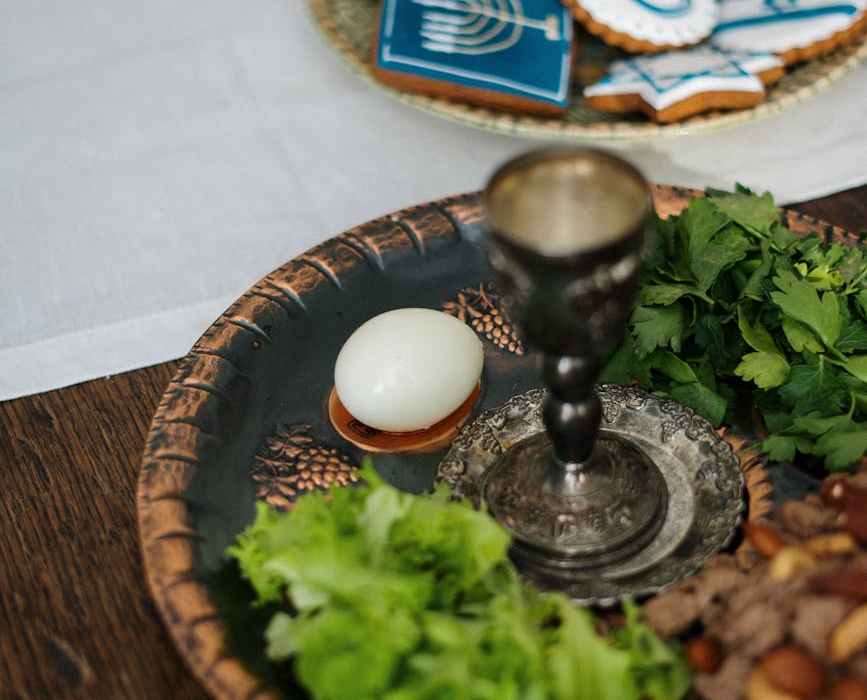
There is a seder plate that represents the various themes of the Haggadah (I’ve provided a link to a nifty little video to explain the significance).
Just for fun, My Jewish Learning has also put together a list of vocabulary to help everyone at their first seder. They are:
Passover Greetings (in alphabetical order)
A zissen Pesach — Have a sweet Passover! (Yiddish)
Chag aviv sameach — Have a happy spring holiday! (Hebrew)
Chag kasher sameach — Have a happy and kosher holiday! (Hebrew)
Chag sameach — Have a happy holiday! (Hebrew)
Moadim l’simcha — May your times be joyous! (Hebrew, said only during the Hol Hamoed, or intermediate, days of the holiday)
Passover Vocabulary (in alphabetical order)
Afikomen —From a Greek word meaning “dessert.” A piece of matzah that is hidden during the course of the seder , found after dinner, and eaten as dessert at the end of the seder meal.
Arba Kosot — Hebrew for “four cups.” In this case, it refers to the four cups of wine drunk at the Passover seder.
Barekh— The 12th step of the Passover seder, in which Birkat Hamazon, the grace after meals is said.
Beitzah — Hebrew for “egg.” A roasted or hard-boiled egg is placed on the seder plate to symbolize rebirth.
Chad Gadya —Aramaic for “one goat,” this is the last of the songs sung at the conclusion of the seder and tells the story of the little goat a father bought for a pittance. Listen to the song below. Find lyrics here.
Chag Ha Aviv — Hebrew for “The Spring Holiday.” One of the alternate names for Passover.
Dayenu — Hebrew for “enough for us,” this is the name of a song sung at the Passover seder that tells of all the miracles God performed for the Israelites. Listen to it and see the transliteration in this video below.
Gebrochts — Yiddish for “broken,” this refers to matzah that has absorbed liquid. It is customary among some Orthodox Ashkenazi Jews to avoid gebrochts as an extra stringency on Passover.
Haggadah — Hebrew for “telling” or “recounting.” A Haggadah is a book that is used to tell the story of the Exodus at the seder. There are many versions available ranging from very traditional to nontraditional, and you can also make your own.
Hallel — The 13th step of the Passover seder, in which psalms of praise are sung.
Hametz — Bread or any food that has been leavened or contains a leavening agent, hametz is prohibited on Passover.
Haroset — A sweet mixture of nuts, wine, and apples on the seder plate that symbolizes the mortar used by slaves in Egypt.
Hol HaMoed — The intermediate days of the holiday, between the first two days of holiday, and the last two days of holiday.
Kaddesh — The first step of the Passover seder, in which a blessing over a glass is recited.
Karpas — The third step of the Passover seder, in which a piece of greenery such as parsley is dipped into salt water and then eaten.
Kitniyot — Hebrew for legumes, the term here also includes corn and rice. These items were prohibited for use on Passover by some Ashkenazic rabbis in the medieval period, but many Sephardic Jews (and increasingly Conservative Jews) do allow them on Passover.
Korekh — The ninth step in the Passover seder, in which bitter herbs are eaten together with a piece of matzah.
Maggid — The fifth and most substantial step of the Passover seder, in which the story of the Exodus is recounted.
Maror — Bitter herbs. The eighth step in the Passover seder, in which the herbs (usually horseradish), symbolizing the bitterness of life under Egyptian rule, are eaten.
Matzah — Unleavened bread. According to the Bible the Israelites ate matzah right before they left Egypt. Today matzah is eaten during Passover to commemorate the Exodus from Egypt.
Motzi Matzah — The seventh step in the Passover seder, in which a piece of matzah is eaten.
Nirtzah — The 14th and final step of the Passover seder, in which the night is concluded by saying “Next year in Jerusalem.”
Pesach —Hebrew for “pass over.” Cooked meat that, according to the Bible, was eaten by the Israelites just before they left Egypt.
Rahtza — The sixth step of the Passover seder, in which the hands are washed for a second time, and a blessing is recited.
Seder — Hebrew for “order.” The Passover ritual where family and friends gather on the first one or two nights of Passover to retell the story of the Exodus. The story is told in a particular order, with specific rituals.
Shir Hashirim — The Song of Songs, the text read in synagogue during the Shabbat of Passover.
Shulhan Orekh— The 10th step in the Passover seder, in which the meal is served. Pass the matzah balls!
Tzafun — The 11th step of the Passover seder, in which the afikoman is found and eaten as dessert.
Urchatz — The second step of the Passover seder, in which the hands are washed but no blessing is recited.
Yahatz — The fourth step of the Passover seder in which a piece of matzah is broken in half.
Zeroa — Shank bone. The bone is placed on the seder plate and recalls the blood on the doorposts and the terror and the anticipation of the night of the plague of the first born.
In my family, Passover is always celebrated at my Great Aunt’s house with a big seder and something fun to tie the kids in. The last one I went to had a play before dinner, and a few years ago we had plastic plagues that we all threw at each other during the readings. I miss these traditions when being so far away, and in a country that is not exactly Jewish friendly, but I have not let it stop me from trying to celebrate in my own way.
This year is extra strange given that we are on lockdown and can’t get together even if we wanted to. I’ve got most of the supplies that I need (although there is no matzah at any of the stores I am allowed to go to, and I can’t really be out and about all day trying to hunt it down…I do have some flat crackers though as a stand-in. Same with the Haroset, but I have a sweet jam that should do the trick). Tomorrow I’ll use my electronic version of the Haggadah, stretch out on my couch and have some unlevean bread and some sweet macaroons for dessert.
Hopefully next year I won’t be in lockdown so I can be better prepared with the food options for the seder, and maybe I can talk some of my friends here into attending. So until then, chag sameach everyone and find a fun way to celebrate!
References
https://www.chabad.org/holidays/passover/pesach_cdo/aid/871715/jewish/What-Is-Passover-Pesach.htm

 The Scamp Abroad